
Cost-effective engineering services
Our inspectors and hazardous area classification specialists advise you on risks, mitigation measures, standards, and best practices.
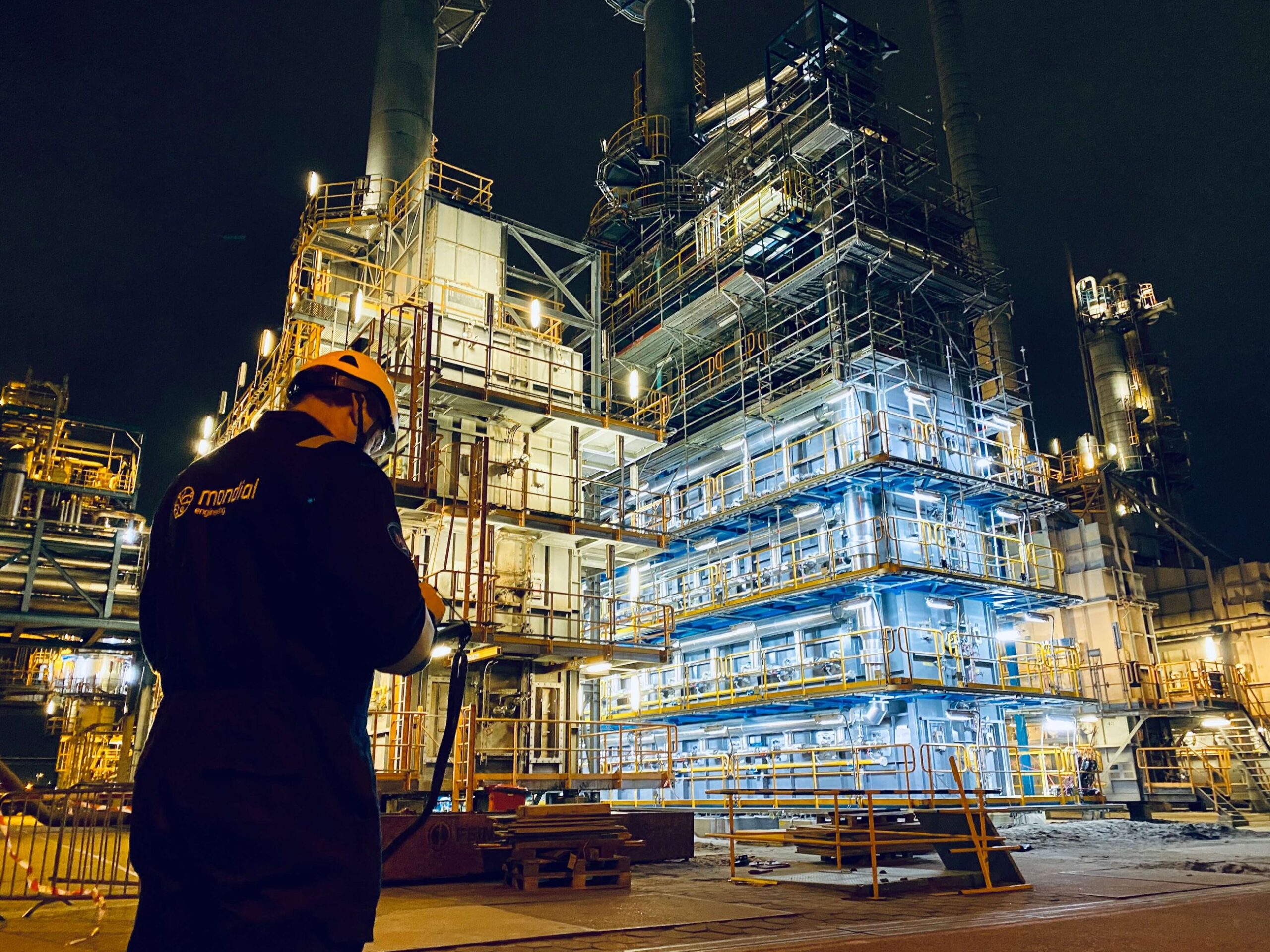

A safe working environment with expert advice and certification in explosion safety.
From the design phase of a project to commissioning, Mondial Engineering offers a wide range of inspection services for electrical and mechanical equipment in hazardous areas. We support and advise our clients regarding ATEX laws and regulations. With decades of experience, our experts deliver effective and pragmatic ATEX 153, ATEX 95, and ATEX 114 inspections.
Whether it concerns design, construction, pre-commissioning, or ongoing operations: our Ex inspections are vital at every stage of your installation’s lifecycle. New installations, for instance, must comply with NEN-EN-IEC 60079-17. A first detailed inspection looks into aspects such as the application of ATEX zoning, temperature class, cable selection, and insulation resistance measurements. Subsequently, periodic NEN-EN-IEC 60079-17 inspections are carried out. This ensures that the status of your installation remains continuously transparent and manageable.
What we do
-
Visual inspection: In this lowest inspection grade, we only look at the externally visible physical aspects of the installation. This is also suitable as an annual inspection and can be seen as preventive maintenance.
-
Close inspection: In addition to performing a visual inspection, this inspection grade also includes checking for the correct equipment certification and suitability for the specific zone.
-
Detailed inspection: In this grade, the close inspection is expanded to include an examination of the internal components of the installation. For this inspection, the installation must be isolated and de-energized.
Electrical installations in your building or plant must, as a matter of course, be fire-safe and secure. A periodic inspection aimed at detecting (potential) defects, carried out by an independent expert, provides you with peace of mind. During a periodic ATEX 153 inspection based on NEN-EN-IEC 60079-17, checks include whether cable connections are safe and match the drawings, whether the earthing is correctly connected, and whether the components used are suitable.
Our inspectors daily inspect and certify various (offshore) locations both domestically and internationally. In addition, we train personnel and provide courses focused on ATEX regulations.
In accordance with ATEX 153 (formerly ATEX 137), explosion-proof installations must be designed, operated, and maintained with the required focus on safety. This ensures both their operational lifespan and explosion safety. This applies not only to electrical equipment, but to mechanical equipment as well.
Inspection plays a vital role in safeguarding the ongoing safety of equipment, personnel, and the surrounding environment. There are three types of inspections for mechanical installations in an ATEX environment:
-
Visual inspection: A visual check of the mechanical installation for aspects such as missing components.
-
Close inspection: This inspection includes all aspects of a visual inspection, but involves the use of tools. Opening up or shutting down the mechanical installation is not required for this.
-
Detailed inspection: An extensive inspection where the installation is opened up or shut down, and test equipment is used if necessary. The IEC 60079-17 standard outlines the frequency of these inspections: initial, periodic, sample, and continuous supervision.
Our experts support organizations daily that deal with ATEX laws and regulations. Whether you are asking “what does this mean for me?” or need a fully developed maintenance plan, feel free to call or email us.
Gaining control over safety and compliance
Keep the status of your installation transparent
With periodic ATEX inspections according to NEN-EN-IEC 60079-17, you maintain continuous control over the safety and compliance of your installation. Mondial Engineering provides insight into all critical aspects: from zoning to cable selection and insulation resistance. This ensures the status of your installation always remains transparent, demonstrable, and easy to manage — even in the long term.